Serial Protocol Monitoring and Decoding: Modbus, DLMS, M-Bus and MASS
In energy and industrial systems, meters, PLCs, sensors, RTUs, and many field devices talk to each other over serial communication protocols. When you develop, commission, or diagnose these devices, the question is usually the same: what is actually going across the wire? To see the answer, you need to monitor the raw data and decode it into meaningful, labelled values. This guide covers the most common serial protocols, the challenges of monitoring and decoding them, and the approaches that make the job practical.
Why Serial Communication Matters
In AMR/AMI (remote meter reading), distribution automation, and industrial control systems, data is usually carried over RS-232, RS-485, or TCP. RS-485 is especially common in the field because it lets dozens of devices share a single twisted-pair line (multidrop).
Reading this layer correctly is critical for billing accuracy, fault diagnosis, device compatibility, and system integration. Even when everything looks fine at the application layer, the real problem is often hidden lower down — a baud-rate mismatch, wrong parity, a bad CRC, or a timing/timeout issue. That is why byte-level visibility answers questions that high-level reports cannot.
The Most Common Serial Protocols
Modbus (RTU / ASCII / TCP)
The common language of industrial automation. It uses a simple register-based model: function codes (e.g. reading holding/input registers, writing registers) access addresses on the device. In RTU mode frames are binary and protected by a CRC-16; ASCII mode is text-based; TCP mode carries it over Ethernet. It is heavily used in PLCs, energy analyzers, and meters.
DLMS/COSEM
The international standard for smart electricity meters. It models data as objects addressed by OBIS codes, and includes HDLC framing, association setup, AES-GCM encryption, and HLS (high-level) authentication. Encrypted sessions must be decoded with the correct key and security suite.
M-Bus
Common in water, gas, heat, and electricity meters, in both wired (M-Bus) and wireless (wM-Bus) variants. Thanks to primary/secondary addressing and a self-describing structure built on DIF/VIF fields, each record states which unit and scale it carries.
IEC 62056-21
A classic standard for communicating with meters over an optical probe or serial interface. It defines Mode A–E sign-on flows: typically a handshake at a low baud rate, then a switch to a higher rate to read ASCII data.
MASS
A local standard used for meter communication in Türkiye. Decoding it correctly matters for compatibility testing for teams working within the local ecosystem.
Tapping the Line: Sniffing and Passive Monitoring
Sometimes you do not want to send commands to a device — you only need to watch the live conversation between two devices. Passive monitoring (sniffing) lets you capture traffic without disrupting the line — for example, to see the real exchange between a data concentrator and a meter. It answers “how does the system behave normally?” rather than “how does it respond to my request?”, and it is especially valuable for catching intermittent faults.
Challenges in Monitoring and Decoding Protocols
The data on the wire is raw byte streams that are hard to interpret by eye. Common practical challenges:
- Decoding raw bytes according to the right protocol and frame boundaries
- Tapping a live line without disrupting it (sniffing)
- Catching the correct baud-rate, parity, and stop-bit combination
- Mapping device-specific register or OBIS maps to meaningful labels
- Decoding encrypted sessions (e.g. DLMS) with the right key
- Running repeatable tests automatically rather than by hand
Automating Testing and Debugging
Monitoring alone is not enough; you often need to run the same scenario again and again: read a range of registers, poll a meter in a specific order, or put dozens of devices on a production line through the same test. This is where scripting and automation come in. With Python-based flows you can define query sequences, validate the responses, and report the results. Going further, you can let an AI agent (AI/MCP) drive the test steps to automate repetitive work.
Typical Field Scenarios
- Meter commissioning: verifying that a newly installed meter answers with the right address, baud rate, and protocol.
- Modbus diagnosis: spotting a wrong register address, a CRC error, or a timeout on an unresponsive device.
- DLMS security check: confirming that authentication and decryption behave as expected in an encrypted session.
- M-Bus reading: addressing multiple meters on a line and reading DIF/VIF values with the correct units.
A Modern Solution: OmniConsole
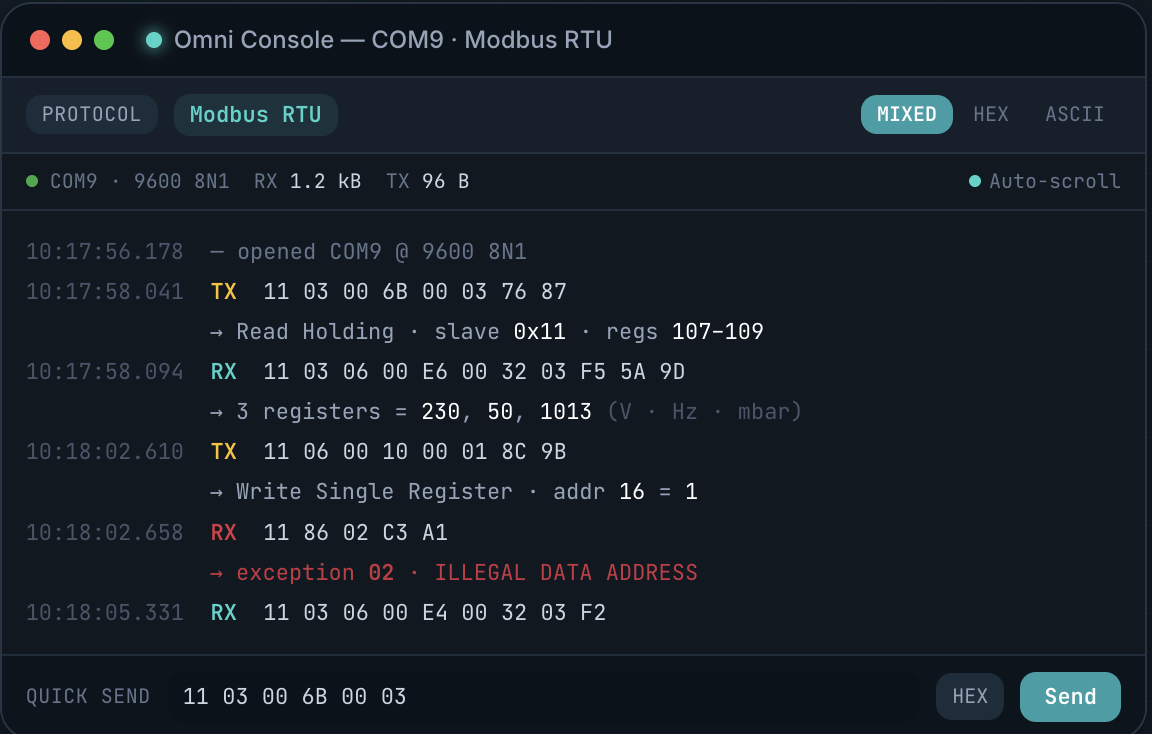
OmniConsole is a cross-platform (Windows & Linux) serial port monitor and protocol decoder that monitors all of these protocols in real time and decodes them into labelled values. Key features:
- Decodes Modbus, DLMS/COSEM, M-Bus, IEC 62056-21, and MASS
- Live line tapping (sniff mode)
- Online device/register library
- Python “flow” automation and AI/MCP control
- Remote (edge) access over SSH and automatic baud-rate
- Ten display modes, frame builders, and export
It positions itself as a modern alternative to classic serial terminal and monitoring tools. There is a free 30-day trial; for details and downloads, visit omniconsole.dev.
Why Choose OmniConsole?
For engineers working with these protocols, the main reasons OmniConsole stands out:
- One tool, many protocols: no need for separate software for Modbus, DLMS, M-Bus, IEC 62056-21, and MASS.
- Automatic decoding: you see labelled, meaningful values instead of raw bytes, so debugging is faster.
- Automation: Python flows and AI/MCP control let you automate repeatable tests.
- Cross-platform and bilingual: runs on Windows and Linux with a Turkish/English interface.
- Remote access: monitor a field serial line remotely over SSH.
- Honest, lifetime licensing: no subscription; lifetime licenses from $39.90 and a free 30-day trial.
Getting Started
Getting going with OmniConsole usually takes a few minutes: download and open the app, select the serial port (or a TCP connection), choose the protocol, and watch the traffic being decoded in real time. Automatic baud-rate detection and the device library take on most of the burden of finding the right settings, so you can focus on the work rather than the setup.
Conclusion
Correctly monitoring and decoding serial protocols is essential when developing smart metering and industrial systems. Most problems hide not at the application layer but deep in the line, and byte-level visibility is what brings them to the surface. If you want to monitor and decode Modbus, DLMS, M-Bus, IEC 62056-21, and MASS traffic in a single tool, automate it with scripts, and access it remotely, take a look at OmniConsole.